About
Saiq’a Shabnam Chowdhury is an artist, animator, and researcher with a long-standing obsession: how do we see and perceive? Where does imagination begin, and where do the thresholds of our perceived worlds collide or mesh together?
It started in college, digging into media archaeology, when she discovered persistence of vision: the neurological quirk that stitches still frames into the illusion of motion. That sent her down a rabbit hole of anaglyph technology, stereoscopy, and eventually her first major work, Old Man of Marshmallow Drive — built around a green-skinned, racially ambiguous character who moved with the unhurried ease of a dancer, soft and precise, unbothered by expectation.
Nonsense literature, surrealism, children’s stories: these were always her languages. Sukumar Ray’s gloriously absurd creatures and wordplay, Satyajit Ray’s precise, humane storytelling, the dreamlike displacement of the surrealists shaped how she thinks, what she notices, and how she builds worlds. They gave her a way to talk about the things that don’t fit neatly anywhere.
The research kept growing.
She became fascinated by the pioneers who had asked these same questions before her. Muybridge photographed a galloping horse and accidentally invented cinematic grammar. Reynaud understood that mirrors and carefully placed reflections could trick the eye into seeing stillness as motion, and built the praxinoscope, a spinning drum of mirrors that transformed sequential images into seamless movement. That same principle lives in Saiq’a’s own praxinoscope work today, the oldest optical magic still working exactly as advertised.
Then there is Marey, who invented a camera modelled on the shape and mechanism of a rifle. A chronophotographic gun, designed to capture birds in flight without killing them. The phrase shooting a photograph comes directly from that device, and something about that origin genuinely moves her: a tool designed for killing, reimagined as a tool for seeing. Violence turned into curiosity. Harm redirected into the precise, patient study of how living things move through the world.
Animation, for her, is a philosophy as much as a medium. Cartoon physics, with its cheerful disregard for the rules, raises genuinely interesting questions about how movement works, how worlds hold together, how the brain makes sense of it all.
She doesn’t just study this at a desk. Her flow arts practice is its own laboratory: spinning props, working with resistance and inertia, learning through the body what gravity actually feels like as a collaborator rather than an obstacle.
The flow state that emerges from deep physical and creative practice — that absorbed, almost trancelike attentiveness that cognitive scientists describe as the brain operating at its quietest and sharpest — is something she chases deliberately, in movement and in making.
She is genuinely delighted by how much pleasure the body is capable of. How art, motion, and focused attention can shift a person’s entire experience of being alive. Understanding that in herself, and finding ways to share it — that’s the thread running through everything.
It found a creative home when she co-founded Ogopogo Studios with filmmaker and close collaborator Amit Ashraf, building a stop-motion animation practice around the conviction that handmade things carry something irreplaceable.
Seven years in, she felt the need for a space where all her interests could exist together without compromise. That became Ghorar Dim “Horse Eggs” Studios (a Bengali metaphor for the absurd): a practice moving between traditional craft, low-tech ingenuity, and whatever fabrication approach the story asks for.
Her working motto is art is a research science. Not as a slogan, but as a genuine method. Like mathematics, art is a universal language: a tool for investigating things that don’t yet have other words.
She is using it to explore movement, perception, pleasure, and the strange, wonderful mechanics of being a body in the world. She is having a very good time doing it.
Download CV (PDF) →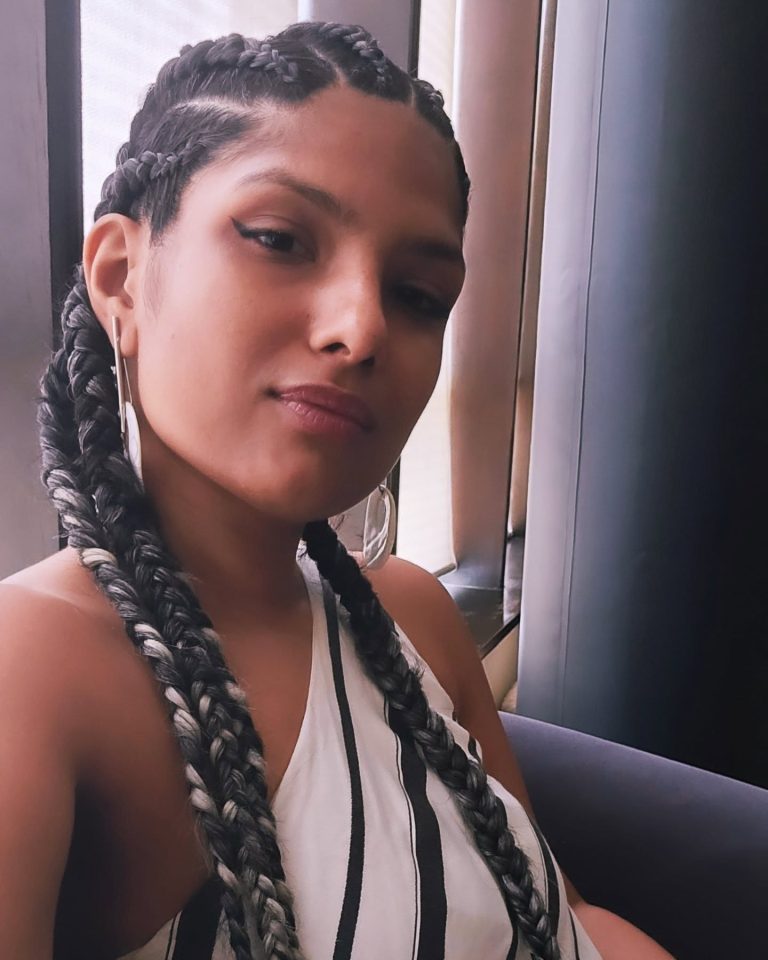
Grants & Awards
| 2027 (updated schedule) | Featured Solo Artist — Solo Art-Science-Tech Exhibition, Dhaka, Bangladesh. A comprehensive interactive gallery sequence merging mechanical optical artifacts, custom spatial lighting layouts, and personal narratives of perception. (Upcoming) |
| 2025–26 | Commissioned Artist & Project Facilitator — WOW (Women of the World) Foundation & British Council (Upcoming August 2026). Production grant to design, model, and direct a human-scale interactive kinetic sculptural Zoetrope exploring physiology and cognitive categorization. Conceptualized and facilitated Embryonic Shifts, a 4-week public workshop series in the Korail community. |
| 2009–13 | Dean’s List Placement (multiple semesters); BFA International Scholarship Recipient — Parsons The New School for Design |
Education
| 2009–13 | BFA in Design & Technology — Parsons The New School for Design, New York, NY. Thesis: Persistence of Nostalgia. |
| 2007–09 | Architectural & Visual Communication Studies — Assumption University (ABAC), Bangkok, Thailand |
Skills
| Animation | Stop-Motion Animation Pipelines, Traditional Hand-drawn 2D, Digital Frame-by-Frame, Motion Graphics, Storyboarding, Asset Illustration |
| Spatial & Making | Blender 3D (Modeling, Sculpting, Spatial Compositing), Digital Fabrication (Laser-Cutting, 3D Printing Prototyping), Physical Prop Design, Armature Fabrication, Clay Modeling |
| Somatic | Flow Arts Practice (Prop Manipulation, Multi-object Coordination, Kinetic Rhythm, Prop and Body Awareness) |
| Software | Adobe Creative Cloud (Photoshop, Illustrator, After Effects, InDesign, Premiere Pro), Final Cut Pro, WordPress Environment, MAMP Distributions. Various AI platforms (Gemini, ChatGPT, Midjourney, Claude). |
| Languages | English (Professional Full Fluency), Bangla (Native Fluency), Hindi (Conversational Proficiency) |