
The Metamorphosis Loop রূপান্তর
Mapping identity, biology, and art through the unresolved form.
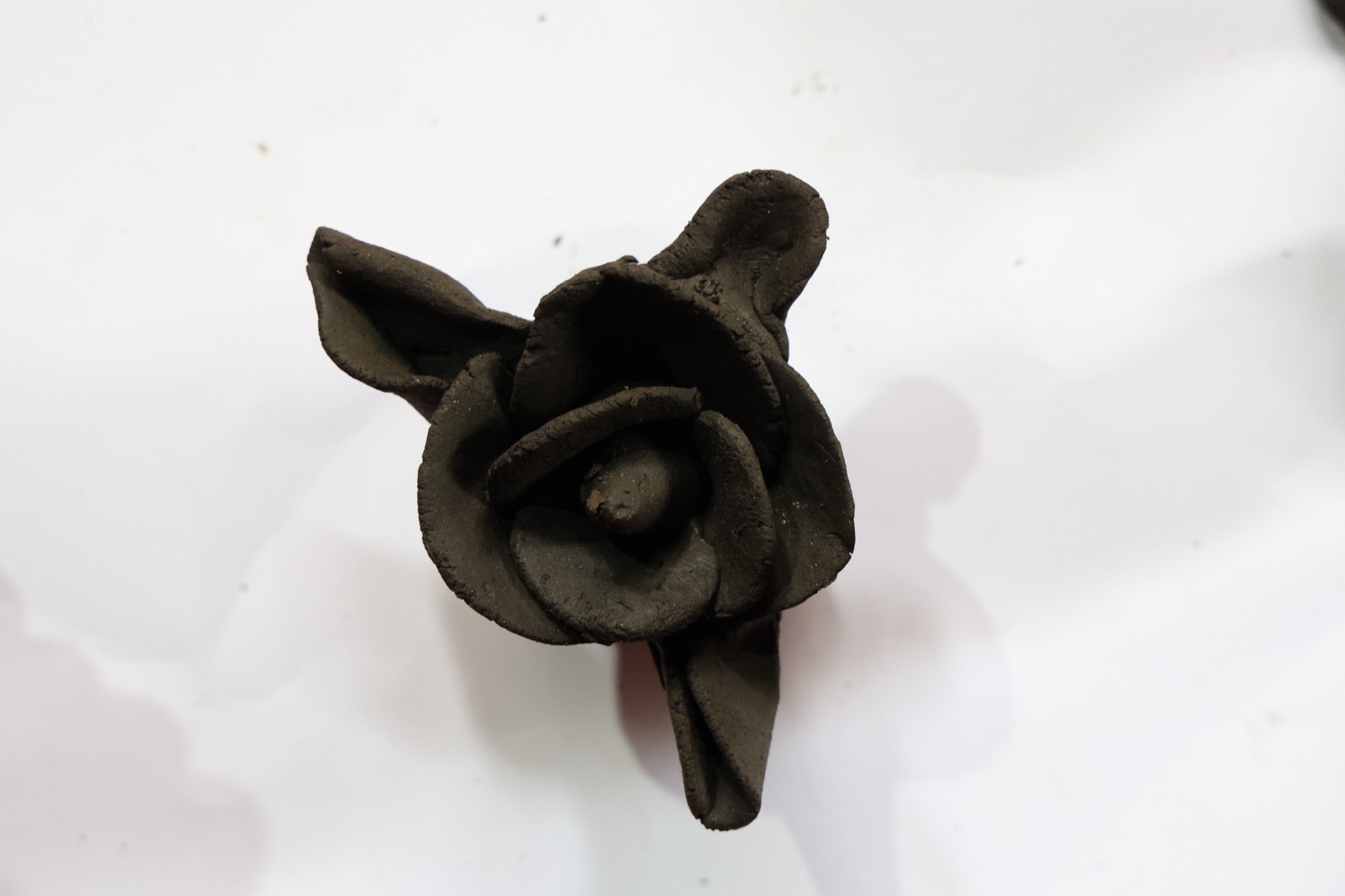
Clay, 3D-printed PLA, motorised rotating structure, stroboscopic lighting, electronics, laser-cut wood frame · 2025–August 2026 · ALOKI, Dhaka · 22–29 August 2026
A bird, a cage, and the gap between them
A thaumatrope (a spinning disc with a different image on each face) holds a bird on one face and a cage on the other. Spin it and the brain reports a bird in a cage — an image that exists on neither side. Embryonic Shifts is built on that fact, and it runs in two directions.
The zoetrope at the centre of this project is traditionally explained by persistence of vision — the idea that the retina holds a faint trace of each image for about a sixteenth of a second, so that successive frames overlap. Modern perceptual science treats that account as incomplete. What actually makes discrete frames read as continuous movement is a pair of brain-level processes: flicker fusion, by which rapid pulses of light above a threshold rate are perceived as steady illumination, and apparent motion — the beta and phi phenomena — by which the motion-sensitive visual cortex infers movement between two still positions.
As the sculpture's platter spins, individual static figures flash briefly under the strobe. Photons strike the retina, where photoreceptors translate light into electrical signals sent along the optic nerve. The motion-sensitive V5/MT region of the visual cortex bridges the dark gaps between flashes, constructing a seamless perception of fluid motion inside the viewer's head. The motion does not exist on the sculpture. It is synthesised by the brain's predictive machinery.
This is the lens the whole project is told through. Outward: what we take to be simply seen is assembled — motion in a zoetrope, a bird in a cage, a stranger's sex from hair and clothing — each stitched from fragments and expectation. Inward: the fragments themselves have a history. Chromosomes come in more than one pair. Body and brain form in separate windows during pregnancy. The brain's own map of the body can expect a shape the skin never reports. Nothing here is a switch; it is a distribution.
Embryonic Shifts points that instrument at one question:
Can gender be represented as an outcome of biology instead of a social or political debate?
The Zoetrope
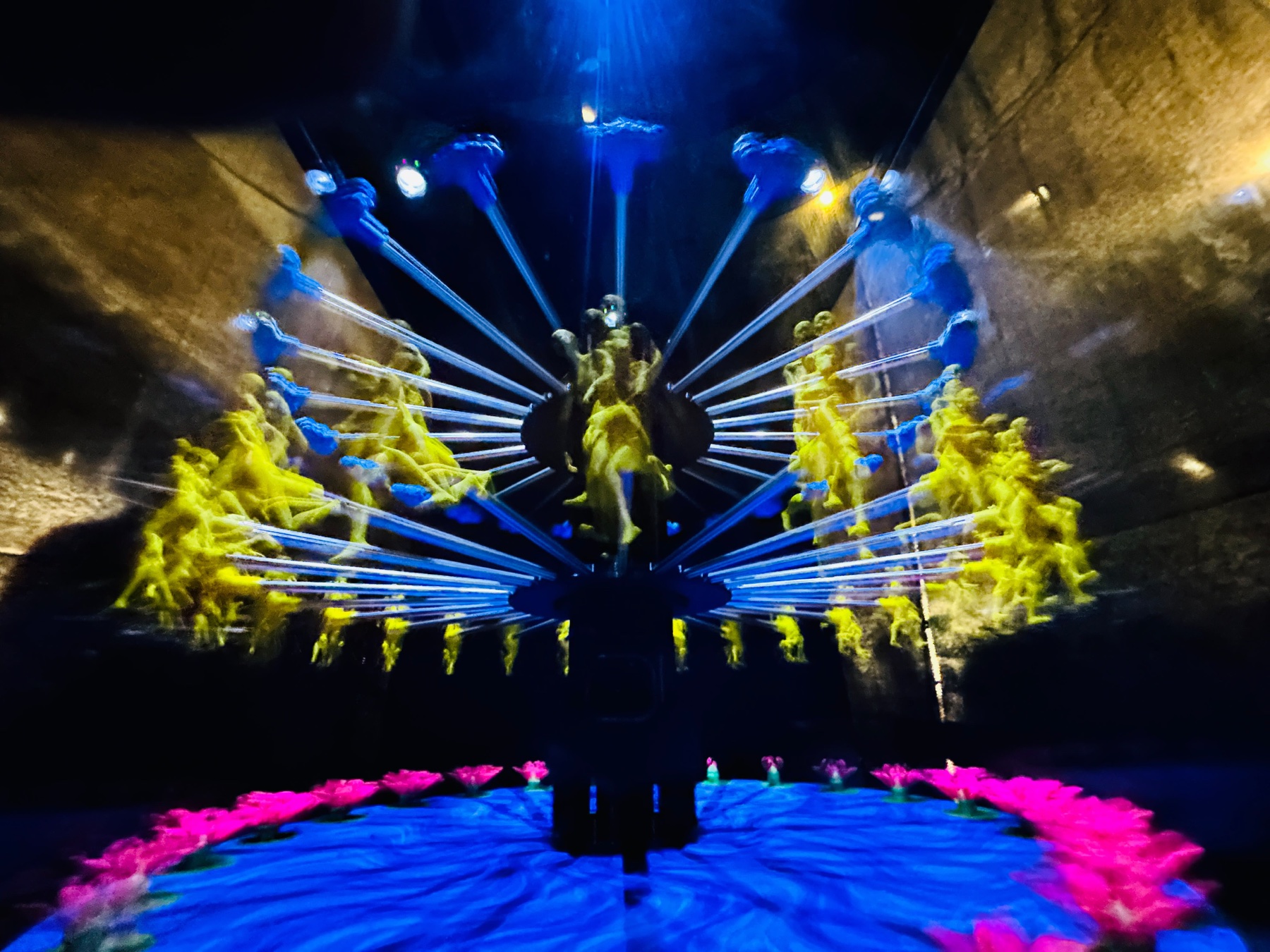
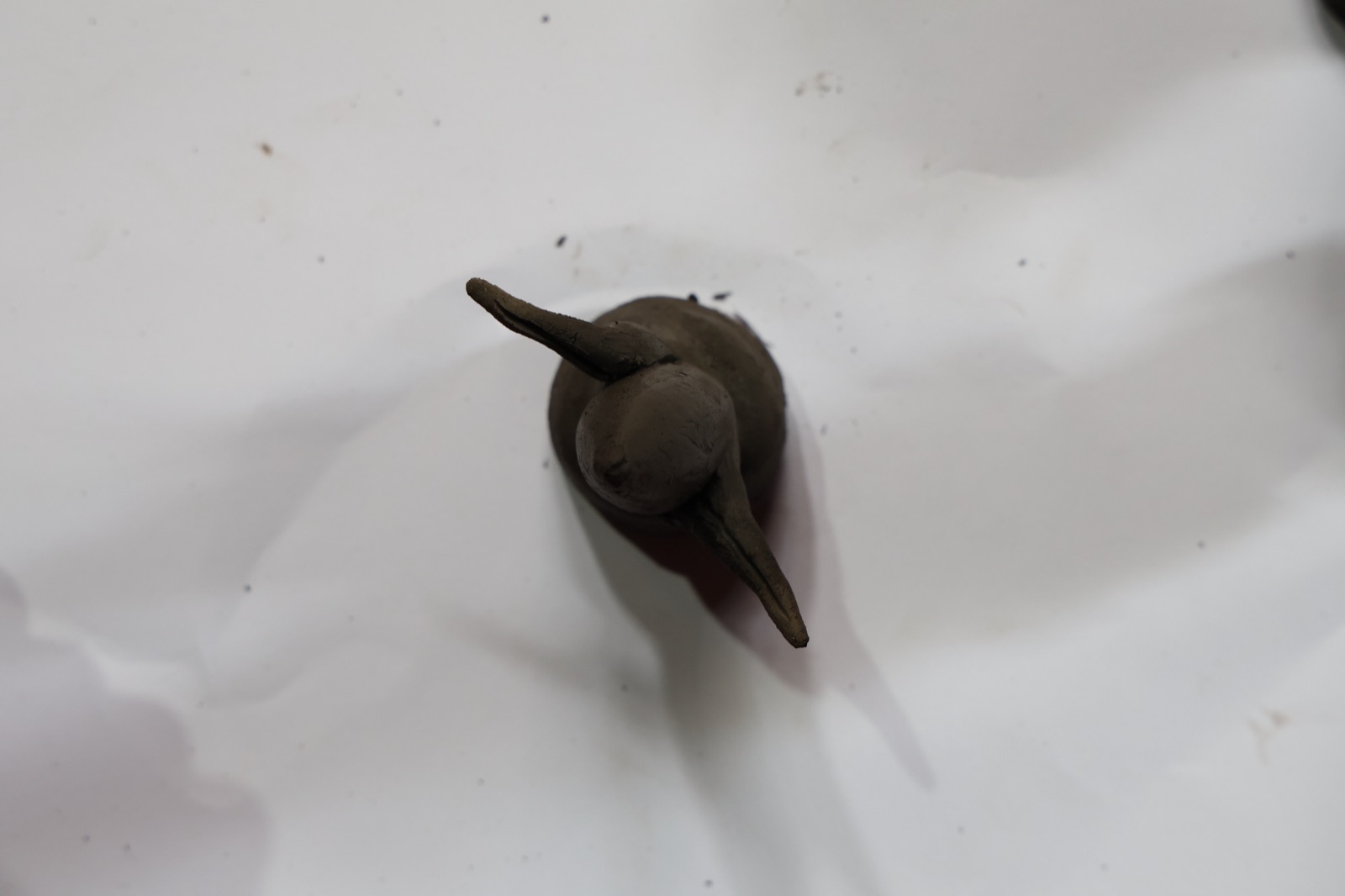
A large-scale kinetic sculpture — clay figures, 3D-printed components, and a laser-cut frame mounted on a motorised, strobe-lit platter — merges static fragments into fluid animation, physically representing identity as continuous motion rather than a fixed state.
- Materials
- 3D-printed PLA components, motorised rotating structure, stroboscopic lighting system, electronics, laser-cut prototype parts
- Dimensions
- Approx. 6 ft high · 843.6 mm platter diameter
- Drive
- 100 rpm BLDC motor, Oldham coupler, 580 mm lazy susan bearing
- Position sensing
- 24× neodymium magnets under the platter, read by a fixed A3144 Hall sensor — one pulse per figure
- Strobe
- 4× torch-head LEDs, ESP32-timed, 300 µs flash per figure, 24 flashes per revolution
- Controller
- ESP32 hardware timer, magnetic contactor with E-stop cutoff on all rails
- Fabrication
- Samiul Hoque
- Year
- 2025 – August 2026
- Exhibited
- ALOKI, Dhaka · 22–29 August 2026
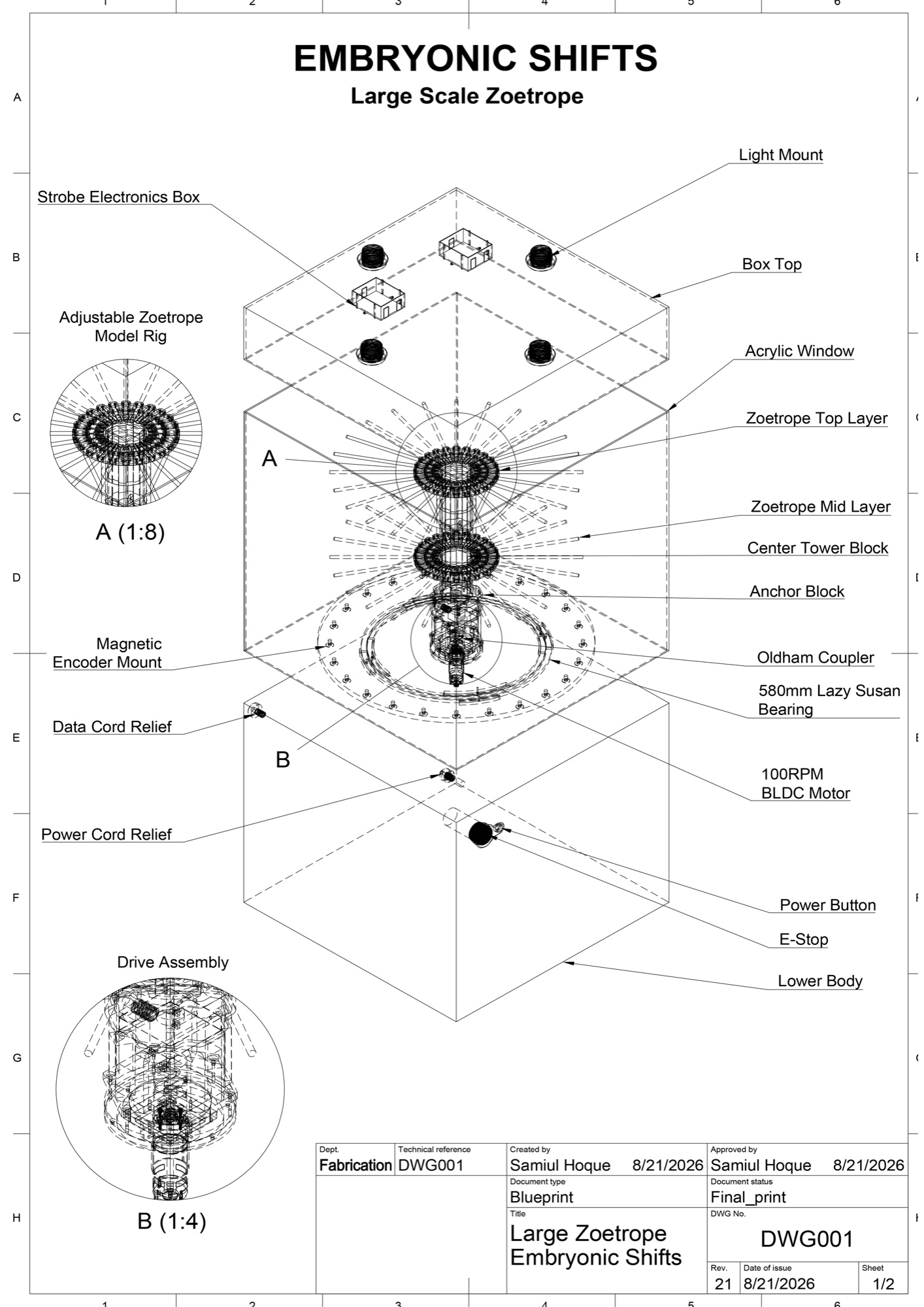
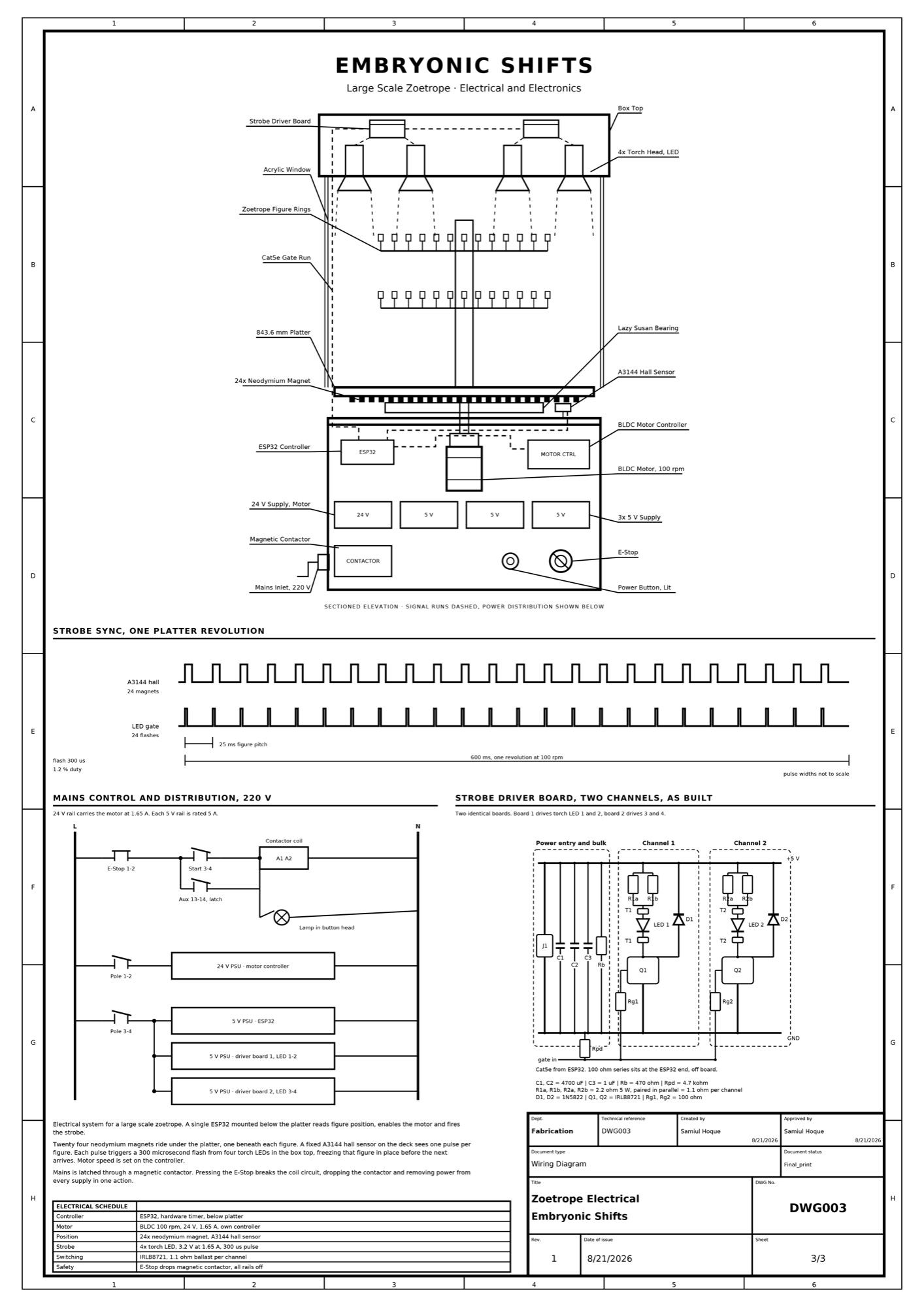
Full build files and schematics by fabricator Samiul Hoque: github.com/samiul-hoque/Embryonic-Shifts
Process
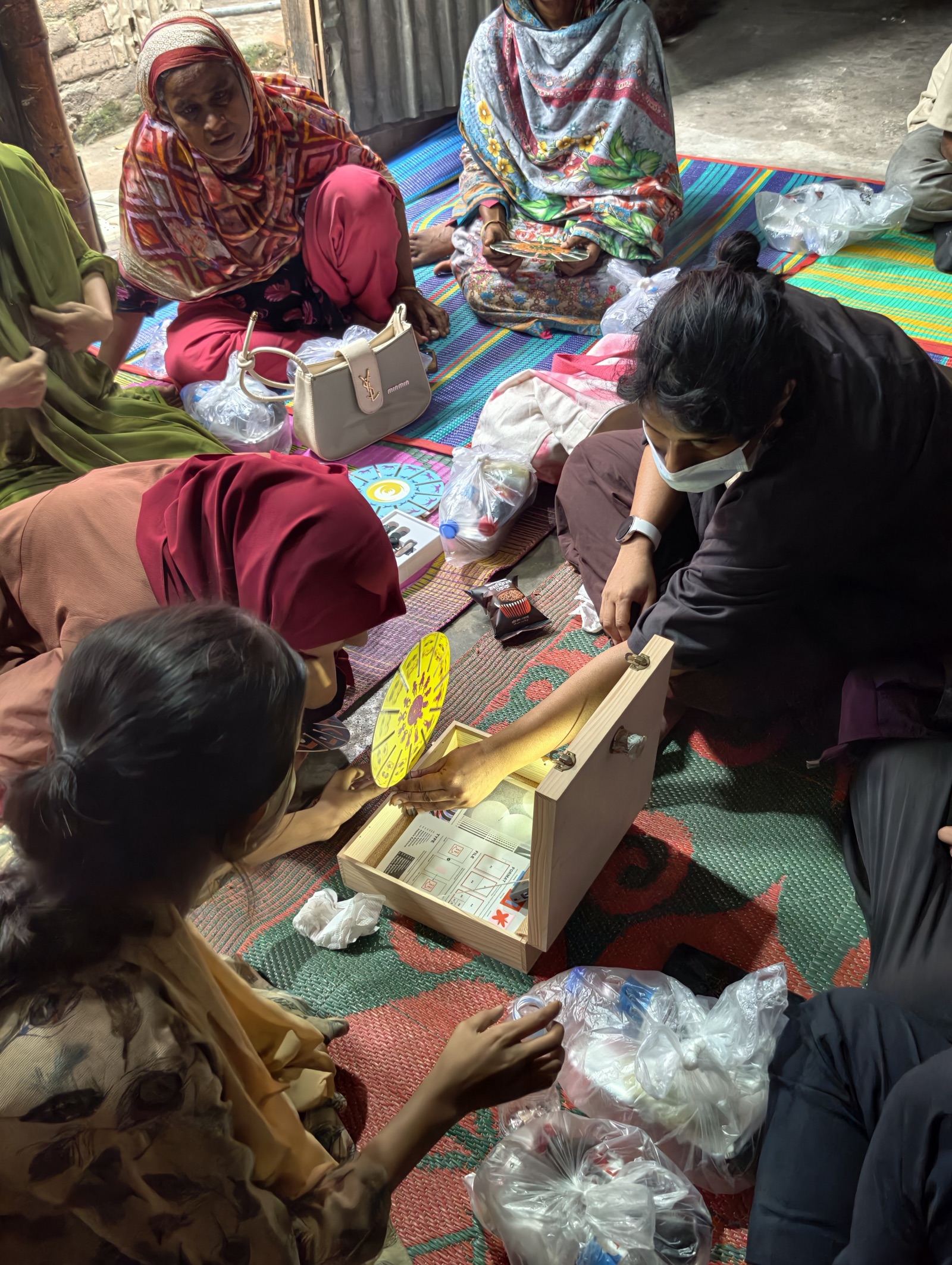
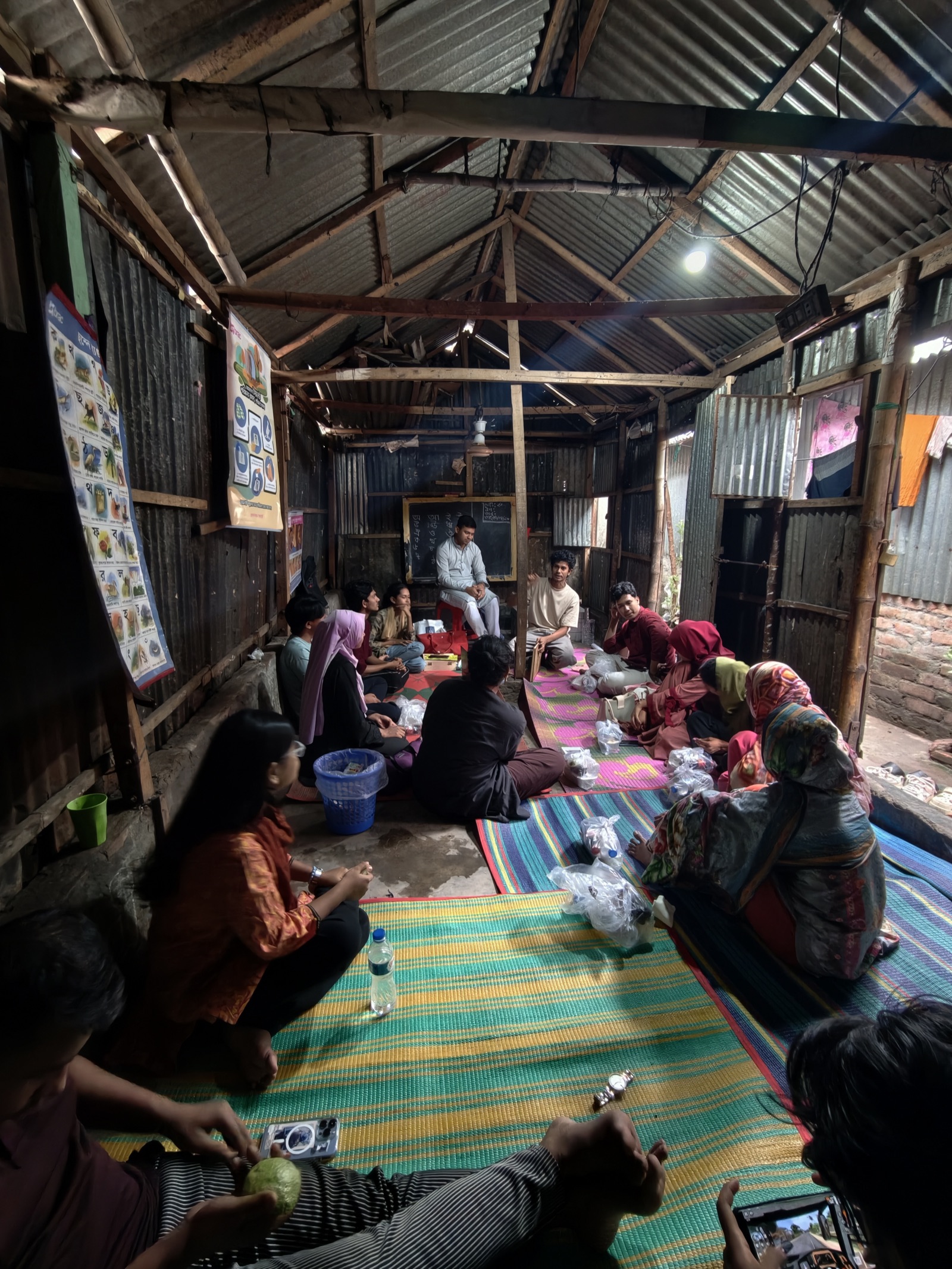
The project began in Korail, the largest informal settlement in Dhaka, with ten participants aged 18–40s, over a four-week workshop series funded by the British Council's WOW (Women of the World) Bangladesh programme. Seven of eight sessions were held inside community rooms in Korail — spaces that had already survived fires and displacement.
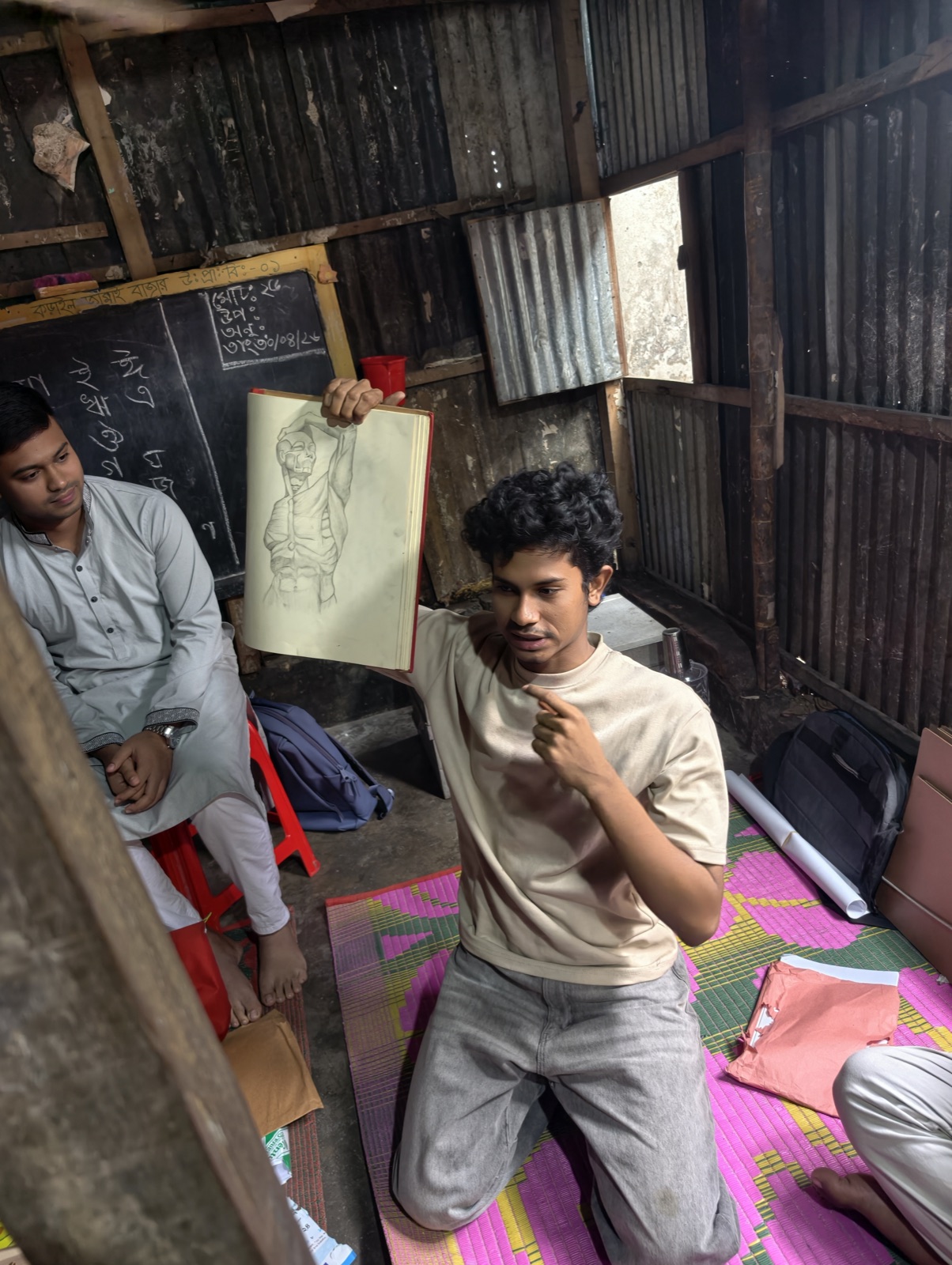
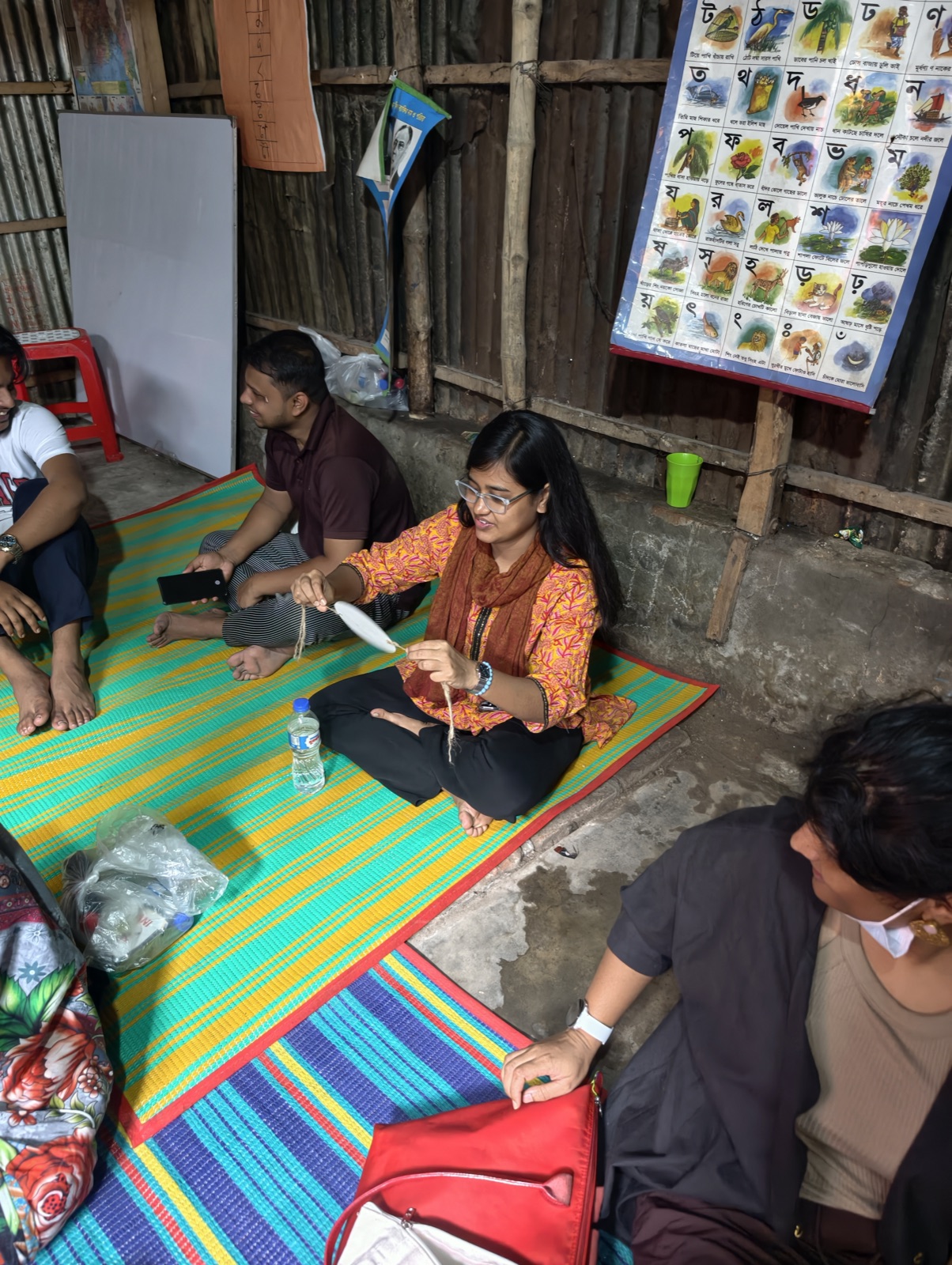
Weeks 1–2 · Mark-making and thaumatropes
Sessions opened with mark-making exercises and hand-built thaumatropes — spinning discs that fuse two images into one through the same optical gap the sculpture later exploits. A Korail community artist offered insight on anatomical observation as a form of scientific practice in its own right.
Week 3 · Comparative embryology and probability
Comparative embryology was paired with probability, using Ludo as a working model of chance. Participants connected genetic variation directly to identity.
"We see that some men have feminine traits, and some women have masculine ones — it is all like the roll of the dice. We can strike the dice, but the outcome does not depend on us." Workshop participant, Korail, Dhaka
Week 4 · Digital workflow and fabrication
The final week moved from hand to machine: smartphone capture, vectorisation of hand-drawn forms, laser-cutting file preparation, and an introduction to 3D modelling in Blender — craft discipline carried alongside new tools.
Facilitator's reflection
Participant resilience ran through every session, despite hardship and destruction from fires in the community. A final group outing became a celebration of personal expression and identity.
Gender and Biology
The conversation around sex and gender often stumbles because it tries to reduce a complex, multi-layered biological reality to a single physical marker. Read through developmental neurobiology, genetics, comparative embryology, probability, and visual optics, human sex and identity are not a switch flipped at conception — they are a synchronised, probabilistic sequence of biological events, interacting continuously with an arbitrary, culturally constructed social environment. Thirteen panels, each with a numbered source range keyed to the bibliography below.
Reading room
Outward: what we take to be simply seen is assembled. Inward: the fragments themselves have a history. What follows is not a verdict but an instrument — a disc, a die, a strobe, a diagram, each a way of watching your own mind fill a gap, and then asking who benefits when the gap is filled one particular way.
Bibliography
Sources behind the ScienceDisplays and the research essay. Prevalence figures and estimates vary by source and population; ranges given are approximate, for context, not diagnosis. Last updated 10 September 2026.
I. Human chromosomal variation — number, structure, mosaicism
- Berglund, A. et al. Changes in the cohort composition of Turner syndrome and severe non-diagnosis of Klinefelter, 47,XXX and 47,XYY syndrome: a nationwide cohort study. Orphanet Journal of Rare Diseases / PMC. pmc.ncbi.nlm.nih.gov/articles/PMC6332849
- Los, E. & Ford, G.A. Klinefelter Syndrome. StatPearls, NCBI Bookshelf, 2023. ncbi.nlm.nih.gov/books/NBK482314
- Klinefelter syndrome (47,XXY). Merck Manual (Professional). merckmanuals.com
- Trisomy 13 (Patau Syndrome). StatPearls, NCBI Bookshelf. ncbi.nlm.nih.gov/books/NBK559091
- Trisomy 18 (Edwards Syndrome). StatPearls, NCBI Bookshelf. ncbi.nlm.nih.gov/books/NBK570597
- Trisomy 13, 18, 21, Triploidy and Turner syndrome: the 5T's. PMC. pmc.ncbi.nlm.nih.gov/articles/PMC3991414
II. Sex as fluid across life — plants, fish, reptiles, fungi, insects
- Sequential hermaphroditism. Wikipedia. en.wikipedia.org/wiki/Sequential_hermaphroditism
- Gender-bending fish. Understanding Evolution, UC Berkeley. evolution.berkeley.edu
- Mechanisms of Sex Determination. Introduction to the Evolution & Biology of Sex, University of Minnesota. open.lib.umn.edu
- Sex Change in Clownfish: Molecular Insights from Transcriptome Analysis. PMC. ncbi.nlm.nih.gov/pmc/articles/PMC5066260
- Gynandromorphism. Wikipedia. en.wikipedia.org/wiki/Gynandromorphism
- Beauty of the dual-gender butterfly. Natural History Museum. nhm.ac.uk
- Jahner, J.P., Lucas, L.K., Wilson, J.S. & Forister, M.L. Morphological Outcomes of Gynandromorphism in Lycaeides Butterflies (Lepidoptera: Lycaenidae). Journal of Insect Science, 15(1), 38, 2015. pmc.ncbi.nlm.nih.gov/articles/PMC7175718
III. Gender identity is not purely socially constructed — the Reimer case
- David Reimer and John Money Gender Reassignment Controversy: The John/Joan Case. Embryo Project Encyclopedia, Arizona State University. embryo.asu.edu
- David Reimer. Wikipedia (see also Diamond, M. & Sigmundson, H.K., 1997, Sex reassignment at birth: long-term review and clinical implications, Archives of Pediatrics & Adolescent Medicine). en.wikipedia.org/wiki/David_Reimer
IV. Heritability of gender identity — twin & family studies
- Gender dysphoria in twins: a register-based population study. Scientific Reports (Nature), 2022. nature.com/articles/s41598-022-17749-0
- Using twin data to examine heritable and intrauterine hormonal influences on transgender and gender diverse identities. Scientific Reports (Nature) / PMC, 2025. pmc.ncbi.nlm.nih.gov/articles/PMC12218214
- Coolidge, F.L. et al. The heritability of gender identity disorder in a child and adolescent twin sample. Behavior Genetics, 2002. pubmed.ncbi.nlm.nih.gov/12211624
V. Prenatal hormones and gendered development — CAH evidence and play behaviour
- Effects on gender identity of prenatal androgens and genital appearance: evidence from girls with congenital adrenal hyperplasia. J. Clinical Endocrinology & Metabolism, 2003. pubmed.ncbi.nlm.nih.gov/12629091
- Gender-role behaviour and gender identity in girls with classical congenital adrenal hyperplasia. BMC Pediatrics / PMC. ncbi.nlm.nih.gov/pmc/articles/PMC8178869
- Gendered Peer Involvement in Girls with Congenital Adrenal Hyperplasia: Effects of Prenatal Androgens, Gendered Activities, and Gender Cognitions. PMC. pmc.ncbi.nlm.nih.gov/articles/PMC9173056
- Hines, M. Prenatal testosterone and gender-related behaviour. European Journal of Endocrinology, 155(Suppl. 1), S115–S121, 2006.
- Hassett, J.M., Siebert, E.R. & Wallen, K. Sex differences in rhesus monkey toy preferences parallel those of children. Hormones and Behavior, 54(3), 359–364, 2008.
VI. Sexual differentiation of the brain — neuroendocrinology and post-mortem studies
- Swaab, D.F. & Garcia-Falgueras, A. Sexual differentiation of the human brain in relation to gender identity and sexual orientation. Functional Neurology, 24(1), 17–28, 2009.
- Garcia-Falgueras, A. & Swaab, D.F. A sex difference in the hypothalamic uncinate nucleus: relationship to gender identity. Brain, 131(12), 3132–3146, 2008.
- Zhou, J.-N., Hofman, M.A., Gooren, L.J.G. & Swaab, D.F. A sex difference in the human brain and its relation to transsexuality. Nature, 378, 68–70, 1995. nature.com/articles/378068a0
- Chung, W.C.J., De Vries, G.J. & Swaab, D.F. Sexual differentiation of the bed nucleus of the stria terminalis in humans may extend into adulthood. Journal of Neuroscience, 22(3), 1027–1033, 2002. jneurosci.org/content/22/3/1027
VII. The brain and gender identity — neuroimaging
- A Review of the Status of Brain Structure Research in Transsexualism. PMC. pmc.ncbi.nlm.nih.gov/articles/PMC4987404
- White Matter Microstructure in Transsexuals and Controls Investigated by Diffusion Tensor Imaging. PMC. pmc.ncbi.nlm.nih.gov/articles/PMC4699258
- White matter microstructure in transmasculine and cisgender adolescents: A multiparametric and multivariate study. PMC. ncbi.nlm.nih.gov/pmc/articles/PMC10931471
- Structural, Functional, and Metabolic Brain Differences as a Function of Gender Identity or Sexual Orientation: A Systematic Review of the Human Neuroimaging Literature. PMC. pmc.ncbi.nlm.nih.gov/articles/PMC8604863
VIII. The body-map in the brain — phantom limbs & body ownership
- Ramachandran, V.S. & McGeoch, P.D. Occurrence of phantom genitalia after gender reassignment surgery. Medical Hypotheses, 69(5), 1001–1003, 2007. pubmed.ncbi.nlm.nih.gov/17420102
- Ramachandran, V.S. & McGeoch, P.D. Phantom penises in transsexuals: evidence of an innate gender-specific body image in the brain. Journal of Consciousness Studies, 15(1), 5–16, 2008. philpapers.org/rec/RAMPPI-2
- Examining the prevalence of trans phantoms among transgender, nonbinary and gender diverse individuals: an exploratory study. 2023. pubmed.ncbi.nlm.nih.gov/37114107
- A New Theory of Gender Dysphoria Incorporating the Distress, Social Behavioral, and Body-Ownership Networks. eNeuro / PMC, 2019. pmc.ncbi.nlm.nih.gov/articles/PMC6911960
IX. Gender dysphoria vs. body dysmorphic disorder — the distinction
- Neural Correlates of Own- and Other-Face Perception in Body Dysmorphic Disorder. PMC. ncbi.nlm.nih.gov/pmc/articles/PMC7196670
- A New Theory of Gender Dysphoria… (see #35) — the body-ownership account distinguishing accurate-perception dysphoria from distorted-perception dysmorphia.
X. The "social influence" debate — contagion claims, rebuttals, referral trends, official review
- Littman, L. Parent reports of adolescents and young adults perceived to show signs of a rapid onset of gender dysphoria. PLOS ONE, 2018 (republished with correction 2019). journals.plos.org
- Restar, A.J. Methodological Critique of Littman's (2018) Parental-Respondents Accounts of "Rapid-Onset Gender Dysphoria." Archives of Sexual Behavior, 2019. ncbi.nlm.nih.gov/pmc/articles/PMC7012957
- Turban, J.L. et al. Sex assigned at birth ratio among transgender and gender diverse adolescents — analysis of the "social contagion" hypothesis. Pediatrics / AAP, 2022. publications.aap.org
- Aitken, M. et al. Evidence for an Altered Sex Ratio in Clinic-Referred Adolescents with Gender Dysphoria. Journal of Sexual Medicine, 2015. pubmed.ncbi.nlm.nih.gov/25612159
- Kaltiala-Heino, R. et al. Time trends in referrals to child and adolescent gender identity services: a study in four Nordic countries and in the UK. 2019. pubmed.ncbi.nlm.nih.gov/31556776
- The Cass Review: Independent Review of Gender Identity Services for Children and Young People — Final Report. NHS England, 2024. cass.independent-review.uk
- Yale Integrity Project. An Evidence-Based Critique of the Cass Review. Yale Law School, 2024. law.yale.edu
XI. Perception and optical devices — how the brain constructs motion
- Anderson, J. & Anderson, B. The Myth of Persistence of Vision Revisited. Journal of Film and Video, 45(1), 3–12, 1993.
- Wertheimer, M. Experimentelle Studien über das Sehen von Bewegung. Zeitschrift für Psychologie, 61, 161–265, 1912. — Origin of the phi phenomenon.
- Zihl, J., von Cramon, D. & Mai, N. Selective disturbance of movement vision after bilateral brain damage. Brain, 106(2), 313–340, 1983. — The classic case of akinetopsia after damage to V5/MT.
XII. Regional history, law and lived experience — South Asia and Islamic jurisprudence
- Reddy, G. With Respect to Sex: Negotiating Hijra Identity in South India. University of Chicago Press, 2005.
- Sanders, P. Gendering the Ungendered Body: Hermaphrodites in Medieval Islamic Law. In Keddie, N.R. & Baron, B. (Eds.), Women in Middle Eastern History: Shifting Boundaries in Sex and Gender, pp. 74–95. Yale University Press, 1991.
- Human Rights Watch. "I Want to Live With My Head Held High": Abuses in Bangladesh's Legal Recognition of Hijras. 23 December 2016. hrw.org
XIII. Contemporary policy — education and sport
- The Business Standard. Govt removes controversial third gender chapter Sharifa's Story from textbook. 26 June 2024. tbsnews.net
- bdnews24.com. Sharifa's Story: debate erupts in Bangladesh over textbook lesson on third gender people. 2024. bdnews24.com
- World Athletics. World Athletics introduces SRY gene test for athletes wishing to compete in the female category. Press release, 30 July 2025. worldathletics.org
- International Olympic Committee. International Olympic Committee announces new Policy on the Protection of the Female (Women's) Category in Olympic Sport. Press release, 26 March 2026. olympics.com
- LawInSport. No 'Y' Allowed: The IOC's New SRY Gene Testing Policy for Female-Category Eligibility. 2026. lawinsport.com
- The Conversation. Sex test used in IOC's new transgender ban more likely to exclude from Olympics intersex women who were assigned female at birth. 2026. theconversation.com
Credits
Facilitation
Ghorar Dim Studios & Saiq'a S. Chowdhury
Fabrication
Samiul Hoque
Partners
MACHAN, PARAA, SHALA neighbourhood art space, ALOKI
Supported by
British Council Bangladesh & Women of the World (WOW) Foundation